
Journal of Interpretation, Translation and Cultural Studies

Journal DOI: 10.15580/jitcs
Vol. 1(1), pp. 1-17, January, 2026
Copyright ©2026, Creative Commons Attribution 4.0 International.
Article’s DOI: 10.15580/jitcs.2026.1.120725014
|
|
Journal of Interpretation, Translation and Cultural Studies |
|
|
|
Journal DOI: 10.15580/jitcs Vol. 1(1), pp. 1-17, January, 2026 Copyright ©2026, Creative Commons Attribution 4.0 International. Article’s DOI: 10.15580/jitcs.2026.1.120725014 |
The impact of indigenous language proficiency on the competence of the modern day literary trainee translator: a paradox of perspective
Thomas Njie Losenje, PhD.
Advanced School of Translators and Interpreters (ASTI), University of Buea.
|
ARTICLE INFO |
ABSTRACT |
|
|
Article No.: 120725014 Type: Research DOI: 10.15580/jitcs.2026.1.120725014
|
This study is based on the premise that the indigenous language or mother tongue can be a veritable catalyst to the competence of the translator on the one hand and the literary trainee translator on the other hand, given that translators try to make sense out of the new linguistic and conceptual world through the linguistic world they are already familiar with. The study therefore, set out to determine how the literary trainee translator’s competence can be enhanced through indigenous language or mother tongue proficiency as well as assess the impact of indigenous language proficiency on the competence of the modern day literary trainee translator. The study employed a survey research design and used the quantitative method to collect data from 50 (fifty) second year students from the 2024/2025 batch of Advanced School of Translators and Interpreters (ASTI), University of Buea. The collected data was analyzed using descriptive and inferential statistical tools comprising frequency counts, percentages, mean, standard deviation as well as multiple response sets. According to the findings, most of the respondents were of the opinion that a good mastery of their indigenous languages was of paramount importance and therefore, has a positive impact on their training, as it helps to build a strong foundation in them while equally enabling them to develop critical thinking, analytical and problem solving skills. The study therefore urges literary trainee translators to endeavour to have a good mastery of their local languages as this can enable them acquire lifelong skills and competences in translation.
|
|
|
Accepted: 15/12/2025 Published: 06/01/2026 |
||
|
*Corresponding Author Thomas Njie Losenje E-mail: thonjilo@gmail.com |
||
|
Keywords: Impact, Indigenous language proficiency, competence, literary trainee translator |
||
|
|
|
Résumé
Cette étude part du principe que la langue indigène ou maternelle peut être un véritable catalyseur pour la compétence du traducteur, d'une part, et du traducteur littéraire en formation, d'autre part, étant donné que les traducteurs essaient de donner un sens au nouveau monde linguistique et conceptuel par le biais du monde linguistique qui leur est déjà familier. L'étude a donc pour objective de déterminer comment la compétence du traducteur littéraire en formation peut être améliorée par la maîtrise de la langue indigène ou maternelle, ainsi qu'à évaluer l'impact de la maîtrise de la langue indigène sur la compétence du traducteur littéraire en formation d'aujourd'hui. L'étude a utilisé un modèle de recherche par sondage et une méthode quantitative pour collecter des données auprès de 50 étudiants de deuxième année de la promotion 2024/2025 de l'École supérieure de traducteurs et d'interprètes (ASTI) de l'Université de Buea. Les données collectées ont été analysées à l'aide d'outils statistiques descriptifs et inférentiels comprenant des comptes de fréquence, des pourcentages, une moyenne, un écart-type ainsi que des ensembles de réponses multiples. Selon les résultats, la plupart des personnes interrogées sont d'avis qu'une bonne maîtrise de leurs langues indigènes est d'une importance capitale et a donc un impact positif sur leur formation, car elle les aide à construire une base solide tout en leur permettant de développer une pensée critique, une capacité d'analyse et de résolution de problèmes. L'étude exhorte donc les traducteurs littéraires en formation à s’efforcer à maitriser leur langue maternelle, ce qui leur permettra d'acquérir des aptitudes et des compétences solides en matière de traduction.
Mots clés : Impact, maîtrise des langues indigènes, compétence, traducteur littéraire en formation
1.1 Introduction
Most studies related to translation and language competence have tended to focus on the role that translation plays in language acquisition, be it the second or third language. This study intends to adopt a paradoxical perspective by investigating how mastery of the local or indigenous language or the mother tongue (MT) can be a catalyst at ensuring the effective training and proficiency of the modern day literary translator. The study is based on the premise that the task of every translator is performed through languages, usually a source and a target language. It is common knowledge that every translator belongs to a culture and should normally speak a language akin to that culture. This language, which is the translator’s native language, is supposed to be the translator’s first source language (SL1). Thus, mastery of the SL1 can be a veritable propeller of the translator’s competence, especially the literary translator who is called upon every day to analyze and translate texts that are replete with cultural elements.
Some scholars have broached the important role that the indigenous language or mother tongue can play in enhancing learning and competence in any subject area. Amongst them is Malone (2010) who notes that “indigenous language is a language education program that helps build a strong education foundation, then bridge successfully into one or more school languages, and then use both or all their languages for life-long learning.” Thus, according to Malone, the indigenous language is pivotal as a result of the fact that it helps to build a solid educational foundation for life-long learning. Nalasco (2012) corroborates the above assertion by affirming that mastery of the indigenous language helps “develop a critical, reasoning and problem-solving skills’’ among pupils, that they can use for life-long learning.
Indigenous languages help not only in life-long learning but equally in the development of every nation. This has long been a subject of interest among linguists. Alimi (2020) notes that “the development and growth of the society largely depends on the language which links the people together.” This is mainly because the people’s culture cannot be fully appreciated without the use of language, which conveys such culture. Thus, to show how important indigenous languages are, Alimi highlights that the Nigerian government pays particular attention to the mastery of the mother tongue. The following submission is worth revisiting:
…Government recognizes the importance of language as a means of promoting social interaction, national cohesion and preservation of our culture. The National Policy of Education (NPE, 2013) endorsed the need for every child to learn the language of the immediate environment, which is the first language, home language, native language or vernacular used by every individual at home (Sumbalan, Caterial, Jimeno and Balane, cited by Alimi, 2020).
From the above, every child is expected to have a good mastery of the indigenous language, which is actually his/her first language, as this will inevitably result in the promotion of social interaction, national cohesion and the preservation of culture. It should be pointed out that most literary texts embody the above three aspects (social interaction, national cohesion and inevitably cultural preservation. Therefore, a student who is knowledgeable and has a perfect mastery of the mother tongue, (the SL1) will find less difficulty identifying and translating such elements from the source language (SL2) to the target language.
The above affirmation is proof of the fact that mastery of the indigenous language does not only undermine the usual dismissive view about its importance in education, but that it has a positive impact on the status of the mother tongue by providing positive learning outcome in the result of trainees vis-à-vis their counterparts without good mastery. Thus, in the words of Sumbalan et al, 2017), it provides “an opportunity for learners to exercise their right to learn in their first language.” Besides, it equally ensures the following as noted by them:
It will enforce additive bilingualism, address the goal of social equality as well as forge equal access to education and equal language rights for all citizens of the democratic country…
Besides the idea of reinforcing bilingualism, the other aspects like social equality, access to education, equal language rights for all citizens, etc. are some of the thematic areas that translators, especially those involved in the translation of literary texts across languages are called upon to translate on a fairly daily basis. Hence, mastery of their mother tongue, in the first place, might serve as a catalyst of competence of the literary translator in analyzing and translating literary texts. That is why this study sets out to investigate the impact of indigenous language proficiency in ensuring the competence of the modern day literary trainee translator.
1.2 The Research Problem
Translation is a vital tool for communication across different cultures and languages. The influence of the indigenous language or mother tongue on the translation process is therefore, a significant factor that is capable of affecting the accuracy and quality of the translated text. Despite the important role played by the indigenous language in overcoming constraints of linguistic and other features such as grammar, vocabulary, syntax, idiomatic expressions and other cultural referents, most studies have tended to focus on the role of translation on language acquisition hence, neglecting to explore how the inherent features of the indigenous language or mother tongue may influence the interpretation and expression of meaning in the process of translating from the source language (SL2) to the target language.
What can be gleaned from the above is therefore the need for mastery or proficiency in the indigenous language by the literary trainee translator, the absence of which can be a deterrent to his/her competence in translation, especially the translation of literary texts replete with cultural referents.
The following concern have been operationalized in the ensuing research questions.
1.3 Research Questions
1. How is the literary trainee translator’s competence ensured through indigenous language or mother tongue proficiency?
2. What is the impact of indigenous language or mother tongue proficiency on the competence of the literary trainee translator?
1.4 Research Objectives
The objectives of this study are to:
1. Determine how the modern day literary trainee translator’s competence can be ensured through indigenous language or mother tongue proficiency.
2. Explain the impact of indigenous language proficiency on the competence of the modern day literary trainee translator.
2.1 Literature Review and Theoretical Framework
In a bid to provide answers to the research questions and attain the objectives of the study, three core concepts have been probed into. The study has reviewed some definitions of translation, after which it has provided key competences that every translator and literary translator should possess. Thereafter, it has attempted to create an interface between indigenous language proficiency and literary translation by discussing on mother tongue proficiency as pivotal to the competence of the literary trainee translator. This section ends by presenting the theories that underpin the study.
2.1.1 Definition of Translation
Translation has been looked into from various perspectives, prominent among which are the linguistic and cultural perspectives. This study adopts an alternative standpoint, by reviewing definitions that consider translation from the process-product point of view. This paradigmatic stance is due to the fact that the latter perspective resonates better with the objectives of this study.
The French theorist Mounin (1963) defines translation as “a series of actions from which the starting point and the final product are indicative of a certain culture, while Halliday (1989) views translation as a “process which makes it possible to establish a connection between two languages and the readers of these language. For his part, Bell (1991) opines that there should be a distinction between translation as a process, translation as a product, and translation in general, that is, what comes about as a result of the union of the two. Thus, according to him, “translation includes several types of texts, ranging from literary to technical.”
Hatim and Munday (2004: 116-117) are in sync with the above process-product perspectives of the art of translation. They emphasize that translation can be analyzed from two perspectives: as a process, which refers to the passage of a message from one language to another and as a product that refers to the translated text.
Munday goes further to highlight the fact that the translator does not have to limit his ability by merely translating but should equally possess the capacity to absorb the text in the original language and in the transmission of the intended message, thus, emphasizing that: “the need for proficiency in both languages, the original and the translation, is clearly not enough to become a competent translator” (Hatim and Munday, 2004:134). Munday’s latter remarks clearly resonates with the overarching goal of this study, which hypothesizes that indigenous language proficiency can be a veritable catalyst towards enhancing the competence of the translator on the one hand and the trainee literary translator on the other hand. This is especially the case when one places the following statement by Hammer, 2009:130) into perspective: “we try to make sense of a new linguistic (and conceptual) world through the linguistic world we are already familiar with.”
2.1.2 The Literary Translator’s Translation Competences
Toury (1995) opines that unlike bilingualism, which is a given, translation competence develops by following the norms peculiar to the culture and society in which the process takes place. Accordingly to this perspective, the success of the translator’s job and consequently his/her competence in performing the job should be determined among other things, by how well it resonates with the culture and society that receive it as well as how successfully it remains entrenched in the source and target cultures.
For his part, Neubert (2000) talks of cultural competence (with emphasis on the cultural background of the source text…) in addition to textual competence (the ability to determine textual features), subject competence (familiarity with the topic of the text), and transfer competence (the ability to resort to appropriate translation strategies and procedures to resolve translation issues). The German scholar, Schafner, agrees with Neubert but adds (re)search competence, which according to him, is the ability to resolve problems that may be triggered by the transfer of a text from one culture to another. Schafner’s thesis is in consonance with the topic under study, which view indigenous language proficiency as key in enhancing the competence of the translator on the one hand and the literary trainee translator on the other hand.
Based on her pedagogical experience with literary translation students, Fox (2000) designed a translation competence model made up of six components: Communicative competence (the awareness of the purpose of the translation task and the ability to produce an adequate target text), socio-cultural competence (the awareness of the socio-cultural context in which the source text emerged and the ability to comprehend texts in the source language and target language culture), language and cultural awareness (the awareness of how language(s) work and convey(s) meaning and the ability to produce target texts that meet the linguistic and cultural expectations of the target audience), learning how to learn (the ability to work with different resources and to record one’s observations), and lastly, problem-solving goals (the awareness of situational, linguistic, cultural and textual problems and the ability to solve them). It should be observed that Fox’s (2000) model is in sync with the present study, as knowledge of the mother tongue or indigenous language (SL1) can be a catalyst for ‘situational,’ ‘linguistic,’ and ‘cultural’ awareness, which will in turn resolve translation problems and hence, ‘’produce target texts that meet the linguistic and cultural expectations of the target audience.”
The above competences are equally complemented by the PACTE Group (2003). They consider translation competence as a system of knowledge needed to translate. This knowledge is made up of inter-related hierarchical sub-competences: linguistic competence (the ability to communicate successfully in the two working languages), as well as a number of extra-linguistic pieces of knowledge and competences: knowledge about the world in general and about its specific areas, instrumental/professional knowledge (ability to use documentation resources and new technologies, knowledge of the market and of the profession) psycho-physiological competence (the ability to use psychomotor, cognitive and attitudinal resources), and strategic competence (including all the individual procedures, conscious and unconscious, verbal and non-verbal, used to solve problems encountered during the translation process.
The above competences are not necessarily exhaustive but represent a checklist of competences that every translator as well as literary translator should possess in order to produce a functionally relevant text in the target language. Apart from these competences, mastery of the mother tongue (indigenous language proficiency, that is, proficiency in the SL1) can enable the translator to be equally competent in the SL2. It is worth observing that ‘knowledge about the world’ as recommended by the PACTE Group starts with knowledge of the translator’s own immediate environment, including his/her own language, culture, habits, and so on. Butzmann (2003:31 concurs with this assertion by affirming as follows:
The mother tongue is the master key to foreign language, the tool which gives us the fastest, surest, most precise, and most complete means of accessing a foreign language.”
Hammer (2009:130) concurs with the above thesis by equally affirming that “we try to make sense of a new linguistic (and conceptual) world through the linguistic world we are already familiar with. The above affirmations lend credence to this study that sets out to investigate the impact of indigenous language proficiency on the competence of the modern day literary trainee translator.
2.1.3 Mother Tongue Proficiency: A Pivot of the Literary Trainee Translator’s Competence
This section focuses on looking at how mastery of the indigenous language or mother tongue can actually enhance the competence of the literary trainee translator. It should be observed that studies in this area are limited and even non-existent, with most of them focusing alternatively on how translation can instead enhance language acquisition. This study rather adopts a paradoxical view by looking at mother tongue mastery and how it can impact translation from two perspectives. The nationalistic and pragmatic perspectives.
The latter perspective (the nationalistic perspective) views indigenous African languages as a panacea to the educational problems facing African leaders. Thus, Prah (cited by Madiba, 2012) notes that literary translators should consider the importance of their indigenous languages in the education in general and the process of translation in particular, in the following words:
My argument is that African languages should be used for the entire educational system. So that Africans in their democratic majorities develop on the basis of their own histories, cultures and languages and also have confidence, self-affirmation and self-reliance in the production and reproduction of knowledge
The Afro-centric approach proposed by Prah explains the crucial relevance of indigenous languages in academic settings, especially when it comes to developing the history, culture and language of its people. In the domain of translation in general and literary translation in particular, knowledge of one’s mother tongue not only serves as a confidence booster, but equally serves the self-affirmation and self-reliance of the literary trainee translator, attributes that are of utmost importance for survival in the translation business.
On the other hand, the pragmatic perspective holds that the determination of the use of any language should be based only on pragmatic considerations (madiba, 2012). This perspective therefore enjoins translators and literary translators to make pragmatic choices in the process of translation, with one the choices being, indigenous language proficiency, which could act as a backdrop for translation competence.
The advantage of the nationalistic and pragmatic approach is that they adopt a holistic approach to language proficiency and transfer competence. Thus, among other things, they shift the focus away from regarding languages as discreet entities to regarding them as flexible, fluid and intermingling. This process can help in developing students’ SL2 language proficiency, hence facilitating competence in translation. Other studies have shown the importance of using language in a complementary manner to facilitate aspects of academic language proficiency. They include higher order thinking skills (Cummings, 2000), multilingual writing (Canagarajah, 2009), concept literacy (Madiba, 2010b), and translanguaging (Creese and Blackledge, 2011), among others. This flexible, fluid and holistic approach is equally supported by Robinson (1996, cited in Madiba, 2012) who contends that “the use of African languages in complementary and equitable fashion alongside other languages will be part of the full development of Africa’s own genius and the continent’s search for its own path to development.”
Besides the nationalistic and pragmatic approach that are complimented by the holistic approach discussed above, other scholars have adopted the simplistic approach to comment about the importance of mother tongue proficiency in facilitating the competence of the literary translator. One of such is Nguyen (cited in Siiman, 2014) who notes that the mother tongue can facilitate students’ understanding of the concepts, lexical, grammatical and academic terms. This, according to him, is due to the fact that the mother tongue is the language in which the individual is most familiar with and has had contact with for a long period of time. The mother tongue therefore, becomes a yardstick for learning and second language acquisition and hence, a safety-valve to navigate through the challenges of translation, since it is helpful in explaining complex ideas and grammar rules, and thus, helps students learn new vocabulary more effectively.
The above submissions, be they nationalistic, pragmatic, holistic or simplistic, point to the fact that indigenous language proficiency can be a veritable catalyst for facilitating competence in translation on the one hand, and literary translation on the other hand among ,trainee translators.
2.2 Theoretical Framework
This study is underpinned by some theories that support the claim that indigenous language proficiency can be a catalyst for language acquisition and by extension translation competence. They include the language transfer theory, the acculturation model and the common underlying proficiency (CUP) theory, presented in the ensuing paragraphs.
2.2.1 The Language Transfer Theory
The word “transfer” in this theory is a psychological derivative. It refers to the psychological process that the knowledge that people have mastered plays a significant role in the new learning environment. One of the proponents of this theory, Xiaoguang (cited by Wang, 2021) submits that language transfer “refers to the learner’s spontaneous and subconscious use of their learned language knowledge (especially mother tongue knowledge) in the process of learning a second language to help the learner produce language.” He equally notes that if the rules of the mother tongue are consistent with the target language, it can promote the acquisition of the second language, which is called positive transfer. On the other hand, if the rules of the target language are not consistent with the mother tongue, it will produce a negative effect on the second language acquisition. Another researcher, Chen (cited by Wans, 2021) looks at language transfer from a more holistic perspective. Thus, he opines that “language transfer also includes the influence of cultural traditions, thinking patterns, social history and other aspects.”
The submissions of both scholars have a direct bearing on this study. Thus, while Xiaoguang’s submission points to the fact that the translator will be able to translate with spontaneity, dexterity and more ease as a result of proficiency in his/her indigenous language, Chen’s affirmation highlights the importance of other factors in the process of translation, amongst them, the influence of culture, thinking patterns, and the rest, as very crucial in ensuring translation competence, and which all budding translators must be cognizant of.
2.2.2 The Acculturation Model
According to Schumann (1986), acculturation is the social and psychological integration of the learner with the target language group. The acculturation hypothesis focuses on two main variables that account for differences in the way learners approach and acquire language: social factors and psychological factors. Thus, while social variables account for the degree of social distance an L2 learner has to the target language, psychological variables involve the individual’s response to the conditions they find themselves in, in the learning process.
Shumann and his followers consider social distance as “an individual’s position or perceived position in relation to the target language (group) and the extent to which they become part of that target language group” (Shumann, 1986, Damen, 1987, Brown, 2007). According to them, social distance can be used to determine the extent of acculturation and how effective a learner is in picking up the L2. Shumann places both social factors and affective/psychological factors on similar scales and asserts that a learner’s success in second language learning is dependent on the amount of acculturation, the degree to which they have reduced the social and psychological distance. (Zaker, 2016).
Schumann’a acculturation model is equally in sync with the necessity for indigenous knowledge proficiency and translation competence in that social and psychological distance with the target language can reasonably be reduced when one is cocksure about his/her proficiency in his/her own mother tongue. Thus, learning a second language becomes psychologically easier when mastery of one’s first language, the mother tongue (SL1) is guaranteed. The learner becomes psychologically apt to interact with other learners of the target language, hence guaranteeing competence in his/her training as a translator. Thus, in the words of Gardner and Lambert (cited by Zaker (2016), “a strong motivation to learn a second language follows from a desire to be accepted as a member of the new linguistic community.”
2.2.3 The Common Underlying Proficiency (CUP) Theory
This theory was propounded by Cummings in 2000. It is based on the learner’s cognitive competence and stipulates that the primary language or mother tongue (SL1) provides a base for competency in the second language (L2, but LS1 for this study). This theory explains the relationship between L1 and L2 and the interaction taking place between both languages. According to this theory, once skills, content and linguistic knowledge are acquired in the mother tongue, they will become beneficial while a student is learning the L2. Thus, in the course of learning and acquiring one language, a student acquires a set of skills and implicit metalinguistic knowledge that can be drawn upon when working in another language.
The relevance of CUP is stated very succinctly by Cummings (2000) in the following words: “conceptual knowledge developed in one language helps to make input in the other language comprehensible. If a child already understands the concepts of ‘justice’ or ‘honesty’ in her own language, all she has to do is acquire the label for these terms in English.”
The relevance of CUP for this study cannot be over-emphasized. On the one hand, it provides a base for mother tongue proficiency and competence in the second language, which can enable the translator replicate concepts seamlessly into the target language. On the other hand, the term CUP explains the fact that there must be a latent or underlying proficiency in the translator’s mother tongue that will serve as a compass and guarantor of competence as s/he navigates through the labyrinth of communicating from one language to another. CUP therefore, becomes the cognitive/academic proficiency that underlies academic performance.
After having reviewed relevant literature and discussed some relevant theories, the study proceeds by presenting the methodology
3.1 Methodology
The study employs a survey research design and it is essentially quantitative, as it set out to assess the impact of indigenous language or mother tongue proficiency on the competence of the modern day literary trainee translator.
3.2 Method of Data Collection
The study collected quantitative data essentially through questionnaires, which were administered to trainee translators of the Advanced School of Translators and Interpreters (ASTI), to determine how the modern day literary trainee translator’s competence is ensured through indigenous language proficiency as well as assess the impact of indigenous language proficiency on the literary trainee translator’s competence. The study therefore made use of the correlational coefficient to test variables.
3.2.1 Sample Size and Sampling Technique
A sample size of 50 (fifty) trainee translators were selected, based on their background in literary translation and translation from and into African languages. The study mostly employed purposive sampling as only second year students of the 2024/2025 academic year were selected, especially those with the above-mentioned backgrounds.
3.2.1 Method of Data Analysis
The quantitative data was analyzed using descriptive and inferential statistical tools. The tools used were frequency counts, percentages, mean and standard deviation, as well as multiple responses set, which aimed at calculating the summary of findings for each variable to ensure comprehension of the overall findings. The addition of mean was to better appreciate participant responses.
In addition to the descriptive statistical tools, the linear regression test was used to verify the impact of indigenous language or mother tongue proficiency on the competence of the literary trainee translator. The linear regression test provides additional information on a unit of improvement in the proficiency of indigenous language on the competence of the literary trainee translator. In addition, to the linear regression test, the Chi-Square test of association was used to demarcate respondents’ views on indigenous language proficiency on the literary translator’s competence. In other words, this permitted the researcher to know the differences in opinion between those who have mastery of their indigenous language or mother tongue and those who do not. Finally, all inferential statistics were presented at 95% confidence interval.
4.1 Data Presentation, Analysis and Results
The data, analysis as well as results have been presented in accordance with the demographic information of the respondents as well as the research questions of the study in the ensuing paragraphs.
4.2 Demographic Information
Table 1: Demographic Information of Respondents
|
Demographic information |
Frequency |
Percentage |
|
Gender (n=50) |
|
|
|
Female |
35 |
70.0 |
|
Male |
15 |
30.0 |
|
Language combination (n=50) |
|
|
|
English A French B |
23 |
46.0 |
|
French A English B |
14 |
28.0 |
|
French A English B Spanish C |
7 |
14.0 |
|
French A English B Arabic C |
2 |
4.0 |
|
French A English B German C |
2 |
4.0 |
|
English A French B German C |
1 |
2.0 |
|
English A French B Spanish C |
1 |
2.0 |
Among the 50 trainee translators sampled, majority 70.0% (35) were female and 30.0% (15) male. Based on the language combination, most of the respondents 46.0% (23) were English A French B, 28.0% (14) were French A English B, while few 14.0% (7) were French A English B Spanish C, 4.0% (2) were French A English B Arabic C, another 4.0% (2) were French A English B German C, 2.0% (1) was English A French B German C, and another 2.0% (1) English A French B Spanish C.
The statistics in Table 1 above are indicative of the fact that respondents emanated from virtually all the language combinations offered by ASTI, hence lending credence to the representativeness of the data. Equally, the predominance of female respondents (70%) over their male counterparts can be explained by the increasing female population at the Advanced School of Translators and Translators (ASTI) as compared to the male population.
4.3 Research Question One: How is the literary trainee translator’s competence ensured through indigenous language or mother tongue proficiency?
Table 2: Knowledge about an Indigenous Language
|
Do you know what an indigenous language is? |
Frequency |
Percentage |
|
Yes |
46 |
92.0 |
|
No |
4 |
8.0 |
|
Total |
50 |
100.0 |
In terms of knowing an indigenous language, majority of the trainee translators 92.0% (46) declared their knowledge about what an indigenous language is against 8.0% (4) who did not what an indigenous language is.
Table 3: Mother Tongue and Competence and Literary Translation
|
Questions |
Frequency |
Percentage |
|
Is a good mastery of the mother tongue a precondition for competence of the literary translator? (n=50) |
|
|
|
Yes |
32 |
64.0 |
|
No |
18 |
36.0 |
|
Can mastery of the indigenous language or mother tongue help in harnessing the skills of a literary translator? (n=50) |
|
|
|
Yes |
48 |
96.0 |
|
No |
2 |
4.0 |
Looking at the role of mother tongue or indigenous language as a tool for competence in literary translation, majority of trainee translators 64.0% (32) accepted that good mastery of the mother tongue is a precondition for competence of the literary translator while 36.0% (18) entertained a contrary view. More so, majority of trainee translators 96.0% (48) affirmed that mastery of indigenous language can help in harnessing the skills of a literary translator while 4.0% (2) denied.
The above statistics point to the fact that mastery of the mother tongue or indigenous language can be a veritable instrument capable of harnessing the competences of not only a literary trainee translator but the trainee translator as a whole. Trainees can therefore be encouraged to master their indigenous languages as this might serve as a catalyst to their competences as modern day translators.
Table 4: Proficiency in Indigenous Language Needed
|
I need to be proficient in my indigenous language even when I do not translate into it. |
Frequency |
Percentage |
Mean |
Std. Deviation |
|
Strongly agree |
27 |
54.0 |
4.40 |
.728 |
|
Agree |
16 |
32.0 |
||
|
Neutral |
7 |
14.0 |
||
|
Disagree |
0 |
0.0 |
||
|
Strongly disagree |
0 |
0.0 |
||
|
Total |
50 |
100.0 |
Furthermore, cumulatively, majority of the trainee translators 86.0% (43) with a high mean of 4.40 accepted that it is necessary to be proficient in their indigenous language even when they do not translate into it while 14.0% (7) were undecided and none rejected. This further reinforces the belief that every good trainee translator must first master their mother tongue before translating into a foreign language. While this is not a precondition, it serves as a pointer to the fact that indigenous language proficiency can actually help in harnessing the skills of a literary trainee translator.
Table 5: Understanding Difficult Concepts and Expressions in Mother Tongue than in English and/or French
|
I can better understand difficult concepts and expressions in my mother tongue than in English and/or French when translating. |
Frequency |
Percentage |
Mean |
Std. Deviation |
|
Strongly agree |
13 |
26.0 |
3.48 |
1.165 |
|
Agree |
12 |
24.0 |
||
|
Neutral |
11 |
22.0 |
||
|
Disagree |
14 |
28.0 |
||
|
Strongly disagree |
0 |
0.0 |
||
|
Total |
50 |
100.0 |
More so, looking at the possibility of understanding difficult concepts and expressions in one’s mother tongue than in English and/or French when translating, cumulatively, 50.0% (25) of trainee translators accepted when compared to 28.0% (14) that disagreed and 22.0% (11) neutral.
The statistics above are in sync with the common underlying proficiency (CUP) theory which stipulates that “the primary language or mother tongue provides a base for competence in the second language.” Cummings’ (2000) submission resonates better when he states that “conceptual knowledge developed in one language helps to make input in the other language comprehensible.”
4.4 Research Question Two: What is the impact of indigenous language proficiency on the competence of the literary trainee translator?
Table 6: Impact of Mother Tongue on Competence of Literary Translators
|
Statements |
Strongly Agree |
Agree |
Neutral |
Disagree |
Strongly Disagree |
Mean |
Std. Deviation |
|
Mastery of my mother tongue can enable me to navigate the challenges of translation. |
11 (22.0%) |
25 (50.0%) |
10 (20.0%) |
4 (8.0%) |
0 (0.0%) |
3.86 |
.857 |
|
The text is easier to translate into English or French when the translator is proficient in his/her indigenous language. |
11 (22.0%) |
12 (24.0%) |
19 (38.0%) |
0 (0.0%) |
8 (16.0%) |
3.36 |
1.290 |
|
Mastery of indigenous language will enable the translator to understand cultural elements within the ST and translate them appropriately in the TL. |
17 (34.0%) |
30 (60.0%) |
0 (0.0%) |
3 (6.0%) |
0 (0.0%) |
4.22 |
.737 |
|
Indigenous language or mother tongue proficiency has a positive impact on the modern-day literary trainee translator. |
11 (22.0%) |
39 (78.0%) |
0 (0.0%) |
0 (0.0%) |
0 (0.0%) |
4.22 |
.418 |
|
Indigenous language proficiency can help build a strong educational foundation for the budding literary translator. |
12 (24.0%) |
32 (64.0%) |
6 (12.0%) |
0 (0.0%) |
0 (0.0%) |
4.12 |
.594 |
|
Indigenous language proficiency can enable the literary trainee translator develop critical thinking, analytical and problem-solving skills. |
10 (20.0%) |
38 (76.0%) |
0 (0.0%) |
2 (4.0%) |
0 (0.0%) |
4.12 |
.594 |
|
Indigenous language proficiency enables the literary trainee translator to translate a source text that meets all the requirements in the target language. |
0 (0.0%) |
30 (60.0%) |
11 (22.0%) |
4 (8.0%) |
5 (10.0%) |
3.32 |
.999 |
|
Overall |
72 (20.6%) |
206 (58.9%) |
46 (13.1%) |
13 (3.7%) |
13 (3.7%) |
3.89 |
.784 |
In aggregate and cumulatively, 79.5% of trainee translators with a high mean of 3.89 confirmed the positive impact of proficiency in indigenous language on the competence of the literary trainee translators while 7.4% responded to the contrary and 13.1% were undecided. Specifically, all trainee translators 100% (50) confirmed that indigenous language or mother tongue proficiency has a positive impact on the modern-day literary trainee translator. Similarly, 96.0% (48) accepted that indigenous language proficiency can enable the literary trainee translator develop critical thinking, analytical and problem-solving skills while 4.0% (2) denied. Similarly, 72.0% (36) of the respondents confirmed that mastery of their mother tongue can enable them to navigate the challenges of translation while 8.0% (4) denied and 20.0% (10) were undecided. More so, 94.0% (47) of the respondents accepted that mastery of the indigenous language will enable the translator to understand cultural elements within the ST and translate them appropriately into the TL while 6.0% (3) held a contrary opinion.
Furthermore, 88.0% (44) of trainee translators acknowledged that indigenous language proficiency can help build a strong educational foundation for the budding literary translator while 12.0% (6) were undecided and none denied. More so, 60.0% (30) of trainee translators agreed that indigenous language proficiency enables the literary trainee translator to translate a source text that meets all the requirements in the target language while 18.0% (9) denied, and 22.0% (11) were undecided. Lastly, 46.0% (23) of trainee translators affirmed that the text is easier to translate into English or French when the translator is proficient in his/her indigenous language while 16.0% (8) denied, and 38.0% (19) remained neutral. The overall finding is also presented on the figure below.
Figure 1: Distribution of Trainee Translators by Opinion on Proficiency in Mother Tongue and Competence of the Literary Translator
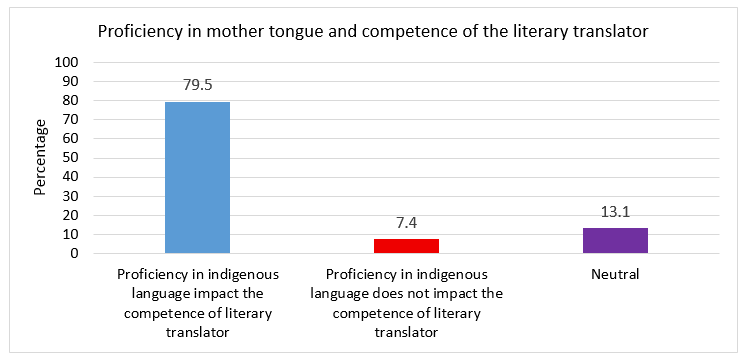
The statistics on the figure above are self-explanatory, with 79.5 percent of the respondents attesting to the fact that indigenous language or mother tongue proficiency has an impact of the literary trainee translator’s competence while 7.4 percent are of the opinion that mastery of the indigenous language does not have any impact on the competence of the literary trainee translator. 13.1 percent of the respondents chose to remain neutral.
Table 7: Comparing Respondents Views of Proficiency in indigenous language on Literary Trainee Translator’s Competence
|
|
Competence of a literary trainee translator |
Total |
Statistical test |
||||
|
See proficiency in indigenous language as impactful |
Does not see proficiency in indigenous language as impactful |
||||||
|
Do you know what an indigenous language is? |
Yes |
n |
39 |
7 |
46 |
Chi-Square Test = 8.220 p-value 0.004 |
|
|
% |
84.8% |
15.2% |
|
||||
|
No |
n |
1 |
3 |
4 |
|||
|
% |
25.0% |
75.0% |
|
||||
|
Total |
n |
40 |
10 |
50 |
|||
|
% |
80.0% |
20.0% |
|
||||
Specifically, when trainee translators’ views of proficiency in indigenous language on literary trainee translator’s competence was examined, a significant association was observed (Chi-Square Test = 8.220, p-value 0.004 < 0.05) whereby majority of respondents who know an indigenous language 84.8% see proficiency in indigenous language as impactful to the competence of the literary trainee translator far more than those who do not know any indigenous language 25.0%. Therefore, experience as they say is the best teacher.
Table 8: Linear Regression Test Depicting the Impact of Proficiency in Indigenous Language on the Competence of the Literary Trainee Translator
|
|
Std. Error |
Beta Coefficients |
p-value |
|
(Constant) |
.874 |
-1.520 (-1.328) |
.135 |
|
Competence of the literary translator |
.032 |
5.970 (.653) |
.000 |
|
Model Summary |
|
|
|
|
R |
.653 |
|
|
|
R-square |
.426 |
|
|
|
Std. Error of the Estimate |
.656 |
|
|
|
ANOVAa |
|
|
|
|
F-test |
35.647 |
|
|
|
p-value |
.000b |
|
|
|
n |
50 |
|
|
Dependent variable: Competence of the literary translator
Predictor: Proficiency in indigenous language/mother tongue
Statistically, proficiency in indigenous language/mother tongue was found to have significant, positive and strong impact on the competence of the literary translator in general and the literary trainee translator in particular (Coefficient value 0.653, F-test 35.647, p-value 0.000 < 0.05). This signifies that for every unit of improvement in the proficiency of indigenous language, the competence of literary translator will increase by 0.653 which is strong. Specifically, those who know what an indigenous language is acknowledged a strong impact on the competence of the literary trainee translators (0.658) more than those who did not know what an indigenous language is (0.322).
4.5 Reliability Analysis
The reliability analysis of this study was based on Cronbach’s reliability analysis report, which shows the consistency or not of the respondents, as shown below.
Table 9: Reliability Analysis Report
|
Reliability Statistics |
|||
|
Cronbach's Alpha Based on Standardized Items |
Item mean |
Variance |
N of Items |
|
.803 |
3.90 |
.170 |
11 |
The internal consistency of the respondents was satisfactory with Cronbach coefficient value of 0.803 above the recommended threshold of 7.0. This is proof of the fact that the sample size of fifty (50) respondents is representative enough for this study.
5.1 Conclusion
This study was based on the premise that mastery of the indigenous language or mother tongue can enhance the competence of the literary trainee translator. Thus, the study adopted a paradoxical perspective by focusing on how the mastery of the mother tongue can be a catalyst for translational competence rather than viewing translation as a tool for language learning and acquisition as posited be several scholars.
The study therefore, set out to determine how the modern day literary trainee translator’s competence can be enhanced through indigenous language or mother tongue proficiency, and explain the impact of indigenous language or mother tongue proficiency on the competence of the modern literary trainee translator. To attain the objectives of the study, a survey research design was employed. Hence, questionnaires were administered to 50 (fifty) second year 2024/2025 students of the Advanced School of Translators and Interpreters, especially those with background in Literary Translation and/or a background in Translation from/into African Languages.
According to the findings, most of the respondents affirmed that they needed to have a good mastery of their indigenous languages or mother tongue, as this does not only enable them to understand difficult concepts and expressions but equally enables them to replicate these expressions during the process of translation from one language into another, in sync with Butzmann’s (2003:31) assertion that “the mother tongue…is the tool which gives us the fastest, surest, most precise, and most complete means of accessing a foreign language.” As far as the impact of mother tongue proficiency in enhancing the competence of the literary trainee translator is concerned, most of the respondents had a positive perspective, hence, affirming that indigenous language proficiency helps to build a strong foundation for the budding literary translator, enables the latter to develop critical thinking, analytical and problem solving skills as well as translate texts that meet the requirements of the target language. This equally resonates well with Cummings’s (2000) underlying proficiency theory (CUP), which stipulates that “the primary language or mother tongue is the base for competence in the second language,” as “conceptual knowledge developed in one language helps to make input in the other language comprehensible.”
The study, therefore urges all literary translation students as well as students interested in translation from/into African languages to do well to master their indigenous languages or mother tongues as this can be a veritable catalyst to their competence in translation, since in the words of Hammer (2009:130) “we try to make sense of a new linguistic (and conceptual) world through the linguistic world we are already familiar with.”
References
Alimi, F.O. (2020). Impact of mother tongue on primary pupils’ literacy and nemeracy skills in Osun State. International Online Journal of Primary Education (IOJPE). Vol. 9 (2), (144-155).
Bell, R.T. (1991). Translation and translating. Longman, London.
Chen, W.C. (2012). How education enhances happiness: Comparison of mediating factors in four East Asian countries. Social Indicators Research. Vol. 106 (1), (117-131).
Creese, A. and Blackledge, A. (2011). Ideologies and interactions in multilingual education: What can an ecological approach tell us about pedagogy? In C. Hélot and M.O. Laoire (Eds.). Language policy for the multilingual classroom. Bristol, UK: Multilingual Matters.
Cummings, J. (1979). Linguistic interdependence and the educational development of bilingual children. Review of Educational Research. Vol. 49 (2), (222-251).
Fox, O. (2000). “The use of translation diaries in a process-oriented teaching methodology.” In Developing translation competence. C. Schaffner and B. Adabs (Eds.). Amsterdam: John Benjamins, (115-131).
Halliday, M.A.K. and Hassan, R. (1989). Language, context and text: Aspects of language in social-semiotic perspectives. Deakin University Presss/Oxford University Press, Australia, Oxford.
Hatim, B. and Munday, J. (2004). Translation: An advanced resource book. New York: Taylor and Francis e-Library. (116-117).
Madiba, M. (2012). Language and academic achievement: perspectives on the potential role of indigenous African languages as a lingua academia. A Journal for Language Learning, (15-27).
Malone, S. (2010). Planning mother tongue-based education programme in minority language communities {resource manual}. SIL International, Asia.
Mounin, J. (1963). Les problèmes théoriques de la traduction. Paris: Gallimard.
Neubert, A. (2020). Competence in language, in languages and in translation. In C. Schaffner and B. Adabs (Eds.). Amsterdam: John Benjamins, 93-18).
Nguyen, V.H. (2012). Mother tongue use in task-based teaching model. Language Teaching. Vol. 5 (8).
PACTE Group (2003). “Building a translation competence model.” In Triangulating translation: Perspectives in process oriented research. F. Alves 9Ed.). Amsterdam: John Benjamins.
Prah, K.K. (2009). The language of instruction in Africa. The language of instruction conundrum in Africa. In Brock-Utne, B. and Garbo, G. (Eds.). Language and power. The implications of peace and development. Dar es Salaam, Tanzania. Mkuki na Nyota.
Schaffner, C. (2000). “Running before walking?” Designing a translation programme at undergraduate level,” In C. Schaffner and B.Adab (Eds.). Developing translation competence. Amsterdam: John Benjamins, (143-157).
Shumann, J.H. (1986). Research on the acculturation model for second language acquisition. In R.C. Gingras (Ed.). Second language acquisition and foreign language teaching (27-50). Washington: Center for Applied Linguistics.
Sumbalan, E.B,. Cterial, D., Jimeno, N., and Balane, C.T. 92017). The utilization of mother tongue in teaching young learners: Its implications to pre-service teachers. Journal of Educational and Human Resource Development. Vol. 5, 915-22).
Toury, G. (1995). Descriptive translation studies and beyond. Amsterdam: John Benjamins.
Wang, S. (2021). The application of language transfer theory in foreign language writing teaching. IAR Journal of Humanities and Social Science. Vol. 2 (4). (35-38).
Zaker, A. (2016). The acculturation model of second language acquisition: inspecting weaknesses and strengths. Indonesian EFL Journal. Vol. 2 (2). (80-87).